Dear friend, you are reading my second article describing the background of my company. In these articles I share my knowledge and competence gathered over 40 years in the nuclear power business.
During recent 20 years I have been an eager participant in the nuclear power plant (NPP) projects in Finland. I have also increased my expertise in improving the safety and performance of operating NPP units in Finland. I have also participated in the high-level evaluations of foreign NPP projects and their design work. This has given me a unique, international perspective and an understanding on best practices in the nuclear power design and construction. My knowledge is also available if you would like to offer me a consultant work contract in a nuclear newbuild project.
My experiences today and in the past
Recently, I’ve been trying to promote the company’s operations and get the first orders. I still have a lot to learn when it comes to being an independent entrepreneur, but I’m looking forward to getting my company started.
One of the surprises has been that some people expect me to go back to the beginning. Many years ago, I started as an eager young man who was paid an intern’s salary and who started in routine work under the guidance of older colleagues and according to the operating models given from above. Even as a fresh engineer at the time, I was able to take responsibility very quickly for making and developing, and guide things according to safe and natural operating models. At that time, my salary increased more slowly than my responsibilities, because my enthusiasm to do new things was huge. However, the results of my work with my colleagues remained alive in Finnish nuclear power routines and facilities in power operation.
Now I would participate in new nuclear power plant (NPP) construction projects and make development with the same attitude, and even better, because the young man’s enthusiasm has been complemented by years of know-how and experience. I would still like to take part in a nuclear power plant project, where sufficient know-how and enthusiasm could be combined. It is surprisingly difficult to find such a project in today’s polarizing world of opposites.
Ongoing nuclear newbuild
The huge need to find emission-free and steadily producing energy sources has led to a rapid increase in the number of nuclear new-build projects. European Governments are encouraging the development and rapid uptake of innovations related to nuclear power. The politically promising Small Modular Reactors (SMR) are waiting to come in some years. However, in most European countries, heavy licensing and regulation of nuclear power will postpone the start-up of the first SMR plant for at least ten years. Unfortunately, when examining the new European NPP projects and their struggle with thistles in the beginning, one feature jumped out at the eyes. It is the lack of competence. Unfortunately, mere will, and desire are not enough in building a nuclear power plant and maintaining its safety culture – know-how and intelligence are necessary.
Several European Governments are now promoting the financing solutions for nuclear power projects. The Governments are reforming national legislations and nuclear regulations for smoother construction projects and for SMR technologies. Several NPP projects have been started or are going to be started. Unfortunately, many projects are managed by people with insufficient expertise or whose experience in nuclear power plant projects does not meet the increased requirements. Cost savings are sought for projects by selecting the project’s key personnel and decisive design experts based on the labor price of the costs. Comprehensive expertise is not available on, for example, recent safety regulations, the order of design and project phases and the new challenges brought by digital automation systems. To establish the new-build projects, technical and management models from the IAEA’s instructions are applied for, which are only intended for the inspection of national models and practices that have been considered and selected as correct. Many projects shall find or hire the ability to match optimal project requirements and nuclear standards-based schedules with key national regulations.
It is shocking to see; how the nuclear power is marketed with the SMR concepts. For the SMR designs with numerous first-of-a-kind (FOAK) solutions and systems, final design, safety assessment and regulatory licensing process are said to be completed in two or three years, and the facility will then be built in another two years. We should believe that the SMR units will be completed smoothly in five years by scientific people and construction engineers with no previous experience on NPP projects. I could imagine that this kind of marketing will soon burst like a balloon, but hopefully it will leave behind something on which to build a more permanent development in the field of nuclear technology.
Experiences on the Finnish NPP projects
Europe’s decades of nuclear power know-how and the continuous development of nuclear power safety solutions in the 1990s are being overlooked. One of the reasons for this is the difficulties of Finnish projects in the 21st century. These projects tried to apply the principle of continuous improvement of operating units during construction work of the nuclear newbuild project. The large number of changes to the regulations and the design basis of systems and equipment messed up the schedules and stretched the construction schedules and increased costs many times over.
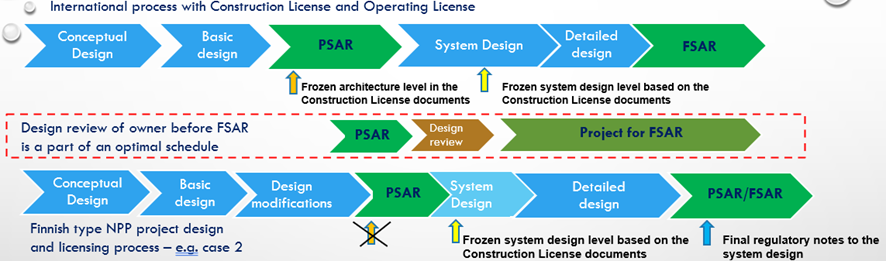
Below you can find my presentation on experiences gained from Finnish nuclear power plant projects. I will add this presentation also to the “Services” page of this website. In this presentation I provide the analysis of certain lessons learned from the construction and modification projects of NPPs. The assessments in the presentation are based on cases 1,2 and 3, which are three construction and preparation projects in Finland during 21st century.
https://nuconeva.fi/wp-content/uploads/2023/08/Nuclear-Projects-lessons-learned-real.pdf